Research | Edward Bach | Timeline

This chronology (by Philip Salmon and Anna Jeoffroy) sets out the milestones in the life of this remarkable man:
a research scientist of the highest calibre with a deep faith in God and Divine Providence.
Use the slider at the foot of this panel to move around the timeline.
Timeline 1880-1950

| 1936 |
close |
| Final illness |
 |
|
|
The strain of a lifetime of work now began to take its toll. For
the second time in his life Bach now became very seriously ill.
He died during the evening of 27 November 1936.
See death
certificate. |
|
| |
| 1936 |
close |
| Twelve
Healers |
 |
|
|
Bach published 'The Twelve Healers and Other Remedies'.
The 38 remedies were placed under the following seven headings
1 For Fear
2 For Uncertainty
3 For Insufficient Interest in Present Circumstances
4 For Loneliness
5 For Those Over-sensitive to Influences and Ideas
6 For Despondency or Despair
7 For Over-Care for Welfare of Others
|
|
| |
| 1936 |
close |
| Final public
talk |
|
In October 1936 his last public talk was given to a Masonic gathering.
The theme of the talk was ‘Disease is Curable’. |
|
| |
| |
close |
| Dr Bach's
membership of the freemasons |
 |
|
| 1918 |
Initiated in the London Warwickshire Lodge, Number
3846 (Mother Lodge) on 25 November. |
| 1920 |
Joins the Royal Hampton Court Lodge, Number 2183 on 20 February.
Joins the Norbury Lodge, Number 4046 on 6 October.
(Dr Bach's father, Walter Best Bach, was
initiated in St Pauls Lodge, Number 43, Birmingham, on 25 October
1920. He resigned from the lodge on 24 November 1930.) |
| 1924 |
Senior Deacon, London Warwickshire Lodge |
| 1925 |
Senior Warden, London Warwickshire Lodge, until 1927 |
| 1926 |
Worshipful Master, Royal Hampton Court Lodge |
| 1928 |
Master, Norbury Lodge, until 1929 |
| 1928 |
Master, London Warwickshire Lodge (30 April) |
| 1929 |
Installs successor, London Warwickshire Lodge (29 April) |
| 1933 |
Honorary Member, Norbury Lodge |
| 1933 |
May; excluded for three years from London Wawickshire Lodge for
non-payment of fees. |
| 1936 |
Granted ten guineas from the Norbury Lodge Benevolent Fund (5
February) |
|
|
| |
| |
close |
| Dr Bach's
movements |
 |
|
| 1919 |
Nottingham Place, London W1 - laboratories. |
| 1920 |
Park Cresent, London |
| 1928 |
Abergavenny and Crickhowell to find the first flower remedies |
| 1930 |
Bettws-y-Coed, Wales (developed type theory)
Abersoch Wales (there he wrote Heal Thyself)
Pwllheli, Wales
Cromer, Norfolk - August/September |
| 1931 |
Abergavenny, Monmouthshire
Lewes, Sussex where he found Water
Violet
June July in Thames Valley (? Marlow)
Westerham in Kent - made gentian |
| 1932 |
Consulting rooms in Wimpole Street Wrote Free Thyself in Regents
Park. Spent winter in Cromer. |
| 1933 |
April in Marlow, Bucks
Cromer in May
August Abergavenny |
|
|
| |
| 1936 |
close |
| Wallingford
lecture |
 |
|
|
September 24th, his 50th birthday, he gives the first public lecture
on ‘Healing by Herbs’ in the Masonic Hall, Wallingford. |
|
| |
| 1940 |
close |
| Biography |
|
'The Medical Discoveries of Edward Bach Physician'. Nora Week's biography
of Dr Bach. |
|
| |
| 1938 |
close |
| Publication |
|
'To Thine Own Self be True' by Mary Tabor |
|
| |
| 1936 |
close |
| Further
threat from GMC |
|
In January he received a letter from The General Medical Council
threatening to have him struck off the Medical Register if he continues
to use ‘unqualified assistants’. He was by now working
with a small team of assistants. |
|
| |
| 1935 |
close |
| The Second
Nineteen |
|
In February/March he began a new cycle of remedies which were prepared
by the boiling method.
They are Cherry Plum, Aspen, Elm, Chestnut Bud, Larch, Beech, Hornbeam,
Walnut, Star of Bethlehem, Holly, Crab Apple, Willow, Pine, Red Chestnut,
Mustard, Wild Rose, Honeysuckle and Sweet Chestnut. White Chestnut,
which he found in May, is the only one of this group of the Second
Nineteen to be made by the sun method. |
|
| |
| 1934 |
close |
| Moves to
Sotwell |
 |
|
|
In April he moved to the village of Sotwell near Wallingford in what
was then Berkshire, to a house called Mount Vernon. In June he found
Wild Oat near Sotwell.
Wrote 'The Twelve Healers and Seven Helpers', published in July.
'The Story of the Travellers' - the natures of 16 remedies explained
in a short children's story format. |
|
| |
| 1933 |
close |
| Helper
remedues discovered |
 |
|
|
The four helper remedies found: Oak in Cromer, Norfolk; Gorse, in
the Thames Valley and Rock Water and Heather found near Crickhowell
in Wales [above]
Friends in Switzerland sent him Vine and friends from Italy sent
Olive and Vine, prepared by the sun method from his instructions.
|
|
| |
| 1933 |
close |
| Publications |
|
Twelve Great Remedies published in a magazine for Homeopaths.
His book The Twelve Healers and Four Helpers published in the autumn.
|
|
| |
| 1932 |
close |
| Dispute
with GMC |
 |
|
|
During the latter part of 1932 and into 1933 Bach was in correspondence
with the General Medical Council [the body with the legal responsibility
for regulating the medical profession in the UK] who threatened to
strike him off the Medical Register for advertising his remedies in
local newspapers.
This example appeared in the Northern Daily Telegraph of 24 Nov 32.
|
|
| Thanks to Blackburn
with Darwen Library and Information Service for above illustration. |
|
| 1932 |
close |
| Final Twelve
Healer remedy discovered |
|
He returned to Westerham, where he had found Gentian the previous
year, this time to find Rock Rose, the last in the series which he
called 'The Twelve Healers', later to become 'The Twelve Healers and
Other Remedies'. |
|
| |
| 1932 |
close |
| Publication |
|
'Free Thyself' published. |
|
| |
| 1931 |
close |
| Further
remedy discoveries |
|
In June at Lewes in Sussex, Bach found Water Violet and in July near
Westerham in Kent he found Gentian.
He now had 11 of his 12 Healers series but as it was late in the year
he would have to wait until the following spring to find the last one.
|
|
| |
| 1931 |
close |
| Publications |
 |
|
|
February: 'Ye Suffer From Yourselves', an address given in Southport.
Published 'Heal Thyself - An Explanation of the Real Cause and Cure
of Disease'. |
|
| |
| 1930 |
close |
| Moves to
Wales |
 |
|
Early in the year Bach left London and
moved to a small Welsh village near Bettws-y-coed to continue his work
on his group theory and search for new remedies.
Visits Abersoch, a small seaside village a few miles from Pwllheli
in North Wales where he stayed until the end of July. It was here
that he perfected the sun method of extracting the healing properties
of plants and where he wrote 'Heal Thyself'.
|
|
| |
| 1930 |
close |
| Publications |
January: 'An Effective Method of Preparing
Vaccines for Oral Administration' published in Medical World.
February: 'Some New Remedies and New Uses' published in Homoeopathic
World.
'Some Fundamental Considerations of Disease and Cure' published
in Homoeopathic World. |
|
| |
| 1930 |
close |
| Six further discoveries |
 |
|
In August while in Cromer he discovered Agrimony, Centaury, Chicory, Cerato and
Vervain. In September discovered Scleranthus. |
|
| |
| 1930 |
close |
| Cromer |
In 1930 Dr Bach began what was to become a four-year association with the small town of Cromer, in the east-coast county of Norfolk.
We have a photographic archive of the town, made in 2002, although the views depicted will hardly have changed since Bach's time there.
Modem
connection |
Broadband
connection |
 |
 |
|
|
| |
| 1929 |
close |
| Turns from
conventional medicine |
Bach was dissatisfied with using the
products of disease to cure disease and gave up nosode therapy.
‘I wish it were possible that we could present to you seven
herbs instead of seven groups of bacteria.’ He finally found
the solution to his dilemma: ‘yet there is one thing lacking
in the effort to avoid using bacterial nosodes, this vital point
is polarity. The remedies of the meadow and nature, when potentized
are of a positive polarity; whereas those which have been associated
with disease are of the reverse type… Science is tending to
show that life is harmony - a state of being in tune - and that disease
is discord or a condition when a part of the whole is not vibrating
in unison’.
From the end of 1929 he gave up all methods of treatment except ‘the
pure and simple herbs of the field’.
He eventually found that there were 12 groups or predominant states
of mind. These he related to the types of karmic lessons people need
to work through in life.
|
|
| |
| 1929 |
close |
| Publication |
The Rediscovery of Psora, published in
The British Homoeopathic Journal. |
|
| |
| 1928 |
close |
| Publication |
In March The Medical
World published 'An Effective Method of
Combating Intestinal Toxaemia'.
|
|
| |
| 1928 |
close |
| A masonic
dinner, reported by Nora Weeks |
‘Bach had attended the dinner somewhat
unwillingly and was not enjoying himself greatly. To pass the time
he was idly watching the people around him when suddenly he realised
that the whole of humanity consisted of a number of definite groups
of types; that every individual in that large hall belonged to one
or other of these groups. . .
‘He found this a most engrossing occupation, and by the time
the dinner was over he had worked out a number of groups and was
busy in his mind comparing these with the seven bacterial groups.
‘He wondered how this extended group-theory would apply to
disease and its cure - whether the diseases from which these groups
suffered would also bear a resemblance to each other.
‘Then came the inspiration that the individuals of each group
would not suffer from the same kinds of disease, but that all of
those in any group would react in the same or nearly the same manner
to any type of illness.’
From 'The Medical Discoveries of Edward Bach
Physician' by Nora Weeks |
|
| |
| 1928 |
close |
| First discovery
of remedies |
In September, following an intuitive
impulse, he went to Wales where he found the first three of the flower
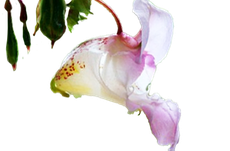
remedies at Crickhowell: Impatiens, Mimulus, and Clematis.
In November, in an address to The British Homoeopathic Society
he referred to the fact that certain plants resembled the bacterial
nosodes in their action. |
|
| |
| 1927 |
close |
| Publication |
At the International
Homoeopathic Congress held in London, Dr Bach read a paper entitled
'The Problem of Chronic Disease' with Drs CE Wheeler and TM Dishington.
|
|
| |
| 1925 |
close |
| Publication |
 |
|
Published 'Chronic
Disease: A Working Hypothesis', written with Dr CE Wheeler who had
assisted him in his research at the London Homoeopathic Hospital. |
|
| |
| 1928 |
close |
| Publication |
In March The Medical
World published 'An Effective Method of
Combating Intestinal Toxaemia'.
|
|
| |
| 1924 |
close |
| Studying
diet and disease |
Dr Bach advised
eating more uncooked food, fruits, nuts, cereals and vegetables to
reduce the amount of toxins produced in the intestines.
At the British Homoeopathic Congress in London he read a paper
entitled 'Intestinal Toxaemia in its Relation to Cancer', discussing
the effects of diet combined with vaccine treatment.
He observed that ‘the benefit obtained is due to general
improvement and not local treatment’. |
|
| |
| 1922 |
close |
| New consulting
rooms |
 |
|
Bach gave up his
post at the London Homoeopathic Hospital and moved to a large laboratory
in Park Crescent [above], off Portland Place. He kept his Harley Street
consulting room where his practice continued to prosper.
|
|
| |
| 1920 |
close |
| Publications |
'The Relation
of Vaccine Therapy to Homoeopathy'
The British Homoeopathic Journal, April 1920.
Bach also read this as a paper to the London Homoeopathic Society in
April 1920
Other publications in 1920:
'The Nature of Serum Antitrypsin and its Relation to Autolysis
and the Formation of Toxins'
FH Teale and E Bach, The Proceedings of The Royal Society of Medicine,
1920.
'The Relation of Autotryptic Titre of Blood to Bacteria Infection
and Anaphylaxis '
FH Teale and E Bach, The Proceedings of The Royal Society of Medicine,
1920.
'The fate of ‘washed spores’ on inoculation into animals,
with special reference to the Nature of Bacterial Toxaemia' by
FH Teal and E Bach, Journal of Pathology and Bacteriology, 1920.
|
|
| |
| 1919 |
close |
| Begins
research into vaccines |
 |
|
In March 1919 Bach was appointed Pathologist
and Bacteriologist at the London Homoeopathic Hospital. [picture
shows the Pathology Laboratory a few years earlier]
Here he works on researching the organisms present in the intestines,
classifying them into seven groups, by means of their fermentation
action on sugar.
The seven groups of bacilli he named were:
1 Proteus
2 Dysentery
3 Morgan
4 Faecalis Alkaligenes
5 Coil Mutabile
6 Gaertner
7 No.7
Vaccines prepared from these groups were found to purify the intestinal
tract.
Each patient was tested for the bacterial group predominant in
the intestines and either an autogenous or polyvalent nosode given.
In the autogenous method a remedy was made of the organism isolated
from a particular patient and given either by injection or by mouth.
To cover a great number of cases a polyvalent nosode, made from collecting
organisms from hundreds of patients then potentizing the whole, was
administered.
|
|
| |
| 1917 |
close |
| Illness |
In July Bach collapsed with severe haemorrhage.
Received surgery for cancer and was given three months to live.
However he recovered and continued with his research work. |
|
| |
| 1917 |
close |
| Second
marriage |
 |
|
Bach was living at 42 Canonbury Square
On 2 May he married Kitty Emmeline Jane Light, then living at 89
Calabria Rd, Islington, about half a mile distant. See marriage
certificate.
|
|
| Photo: Rachel Carter |
| 1918 |
close |
| Influenza
pandemic of 1918 |
 |
|
In the spring of 1918 a flu epidemic
broke out in the trenches among the soldiers fighting the war. By May
it had spread back to the home countries of the soldiers, England,
Germany, the USA and India. In England it quickly spread to become
a very serious outbreak, claiming 228,000 lives (and in India, according
to some estimates, many millions).
Desperate measures to prevent the spread: streets were sprayed and
people wore masks. However both the precautions and the treatments
were ineffectual.
Dr Bach would have been working at university College Hospital during
this terrible epidemic. |
|
| |
| 1915 |
close |
| FIrst World
War |
 |
|
In 1915 Dr Bach was in charge of war
beds at University College Hospital. [image is
contemporaneous but not of UCH]
At the same time, as well as researching into vaccine therapy at
the Bacteriological Department he was also a demonstrator and clinical
assistant to the Hospital Medical School. |
|
| |
| 1914 |
close |
| Further
qualification |
Awarded the Diploma
in Public Health Camb. (Cambridge).
At the outbreak of the First World War, Bach applied to serve
abroad. To his sorrow he was on several occasions refused permission
on health grounds.
|
|
| |
| 1913 |
close |
| Further
qualifications and early appointments |
 |
|
Awarded the degrees MB (Medicinae
Baccalaureus, Bachelor of Medicine) and BS (Bachelor of Science).
Appointed Casualty Medical Officer at University College Hospital
(the famous cruciform building shown above - now a medical school
- had opened in 1906).
Appointed Casualty House Surgeon at the National Temperance Hospital.
He was forced to give up this post after a few months due to ill
health brought on by overwork.
When he recovered he took consulting rooms near Harley Street.
|
|
| |
| 1913 |
close |
| Marriage |
 |
|
On 14 January at the Parish Church of Hendon
in Middlesex, Edward Bach marries Gewndoline Caiger. See marriage
certificate. |
|
| |
| 1912 |
close |
| Qualifies
as doctor |
Bach had moved from
Birmingham University to London to complete his medical training. From
University College Hospital he obtained the Conjunct Diploma of MRCS
(Member of the Royal College of Surgeons) and LRCP (Licentiate of the
Royal College of Physicians). |
|
| |
| 1903 |
close |
| Joins Worcester
Yeomanry |
 |
At the age of 16, Bach joins this miltary
regiment, which had recently returned from South Africa where it had
taken part in the action against The Boers, descendants of the original
Dutch settlers in the Transvaal and Orange Free States, whose ambitions
in the rich region clashed with the British. Lacking sufficient cavalry
to match the versatile and mobile Boers, the British had been forced
to send the 'Yeomanry', part-time volunteer soldiers, among them some
from Bach's local regiment, the Worcesters.
More |
|
| |
| |
| 1903 |
close |
| Brass founding |
Birmingham had been a centre for brass founding
since the early 18th century. Indeed in a city renowned for all types
of metal-working, including iron, gold, silver and gilt, brass-working
was pre-eminent. |
|
| |
| 1886
close |
| Edward
Bach born 1886 |
 |
Edward Bach was the eldest of three children,
two boys and a girl.
Moseley, now a suburb of Birmingham, was at that time a village, situated
about three miles outside the city. |
| Picture shows Moseley village in 1900.
Courtesy Birmingham Public Libraries |
| 1881 |
close |
| From the
census of 1881 |
Walter Bach (Dr Bach’s father) at the
time of the census was 25 years old and unmarried, living at The Hollies,
Alcester Road, Moseley, Kings Norton, Worcestershire. In residence were
his widowed father (Dr Bach’s grandfather), two step sisters, two
nephews, three visitors and two domestic servants. Walter Bach was a
brass founder, born in Birmingham. Walter’s father, also named
Edward Bach, was described as a spur maker (saddler) born in Hopsey,
Shropshire in 1810.
|
|
| |
Can you contribute
some information to
this timeline?
|